Hello from Buenos Aires

Culture of Learning

What does getting lost on the streets of Buenos Aires have to do with high performance? I could see my destination—a restaurant near Puerto Madero—clearly on the map in my hand, yet every turn I made seemed to take me farther away. It made no sense to me. I began to become frustrated. I always thought of myself as having an excellent sense of direction, yet none of my skills were helping me. What was wrong? I was about to give up and call an Uber. ...

August 25, 2019 · 2 min · shlomo

What is a learning organization?

Now that you know why you shouldn’t become a software business, you need to know about becoming a learning organization instead. As discussed, a learning organization rapidly learns about the customer, the problem domain, and the tools they must wield to fill the customer’s need. But what are the ingredients of learning itself? To learn about any subject, the following three elements must be present: A clear purpose. You must have a goal in mind, a challenge you are trying to address, or a question you are trying to answer. Learning only happens when you are actually interested in the subject, as my classmates in my Hebrew class in third grade will attest—it was very boring and I retained next to nothing from that year. On the other hand, when you are genuinely committed to the subject, you will persevere despite challenges. As a child I didn’t have the “rounded” Lego pieces necessary to build the iconic black-and-white Airwolf helicopter, but I devoted hours and hours over several weeks in repeated attempts to constructing the best replica I could from the only pieces I had, mostly blue and grey rectangular bricks. It was really cool (in my pre-teen opinion). And I persevered because I had a clear purpose in mind: to create something really cool. A commitment to and curiosity about truth. Curiosity and commitment to truth are the engines that drive learning via the scientific method. Brook no hidden agenda, accept no propaganda, and harbor no preconceived notion of what the solution must look like. As a young software engineer I once was helping a colleague debug some anomalous software behavior. We interrupted the program to debug it step by step, and watched the internal state of the program while it—we thought—was exhibiting the faulty behavior. Convinced we were witnessing a bug, we tried to explain every observation accordingly. But we failed to reproduce the issue, calling into question all of our explanations. Only afterward, when we allowed the program to continue running to completion, did we understand what had happened: I had pressed the wrong key, which executed a completely different function than the one we were trying to diagnose, so all of our explanations were wrong. Yet we had been doggedly trying to explain how correct they were! Respect the data: If the conclusions don’t match your hypothesis, then the problem is in your hypothesis, not your data. Rooting out frustration. Adam Smith’s “invisible hand” driving economic progress is the human desire to eliminate frustration from our lives. We seek lower prices for commodities because it irks us to pay more than our neighbor pays for the exact same product. We invent new labor-saving devices because less labor means less frustration. Frustration points us to opportunity for improvement. In your organization, what frustrations are important? What are your customers’ frustrations, and what about the frustrations that workers encounter while building and delivering your product or service? These are the frustrations you should identify and seek to eliminate. Too much attention has been paid to “promoting empathy,” which cannot be measured objectively in a corporate setting. Frustration can be identified and measured. Rooting it out forces you to focus on the very areas that are opportunities for improvement. When you have clear purpose, commitment to and curiosity about the truth, and a relentless pursuit of rooting out frustration, learning ensues. You learn about your customers, the problem domain, and your own tools and processes with fresh eyes, open mind, and focused energy. That is what it takes to be a learning organization.

August 4, 2019 · 3 min · shlomo

Don't become a software business, become a learning organization

Watts S. Humphrey famously said, “every business is a software business.” Unfortunately, this statement has been misconstrued by well-meaning IT practitioners to demand primacy in the organization’s strategy, budgeting, and focus. But nothing could be more dysfunctional than letting technology lead your business. A business exists to serve customers, and nothing else matters. Customers don’t care about anything “behind the curtain,” only the elements of your business with which they interact. ...

July 17, 2019 · 2 min · shlomo
Shlomo's Value Investment Vault

The value of planning for unplanned value

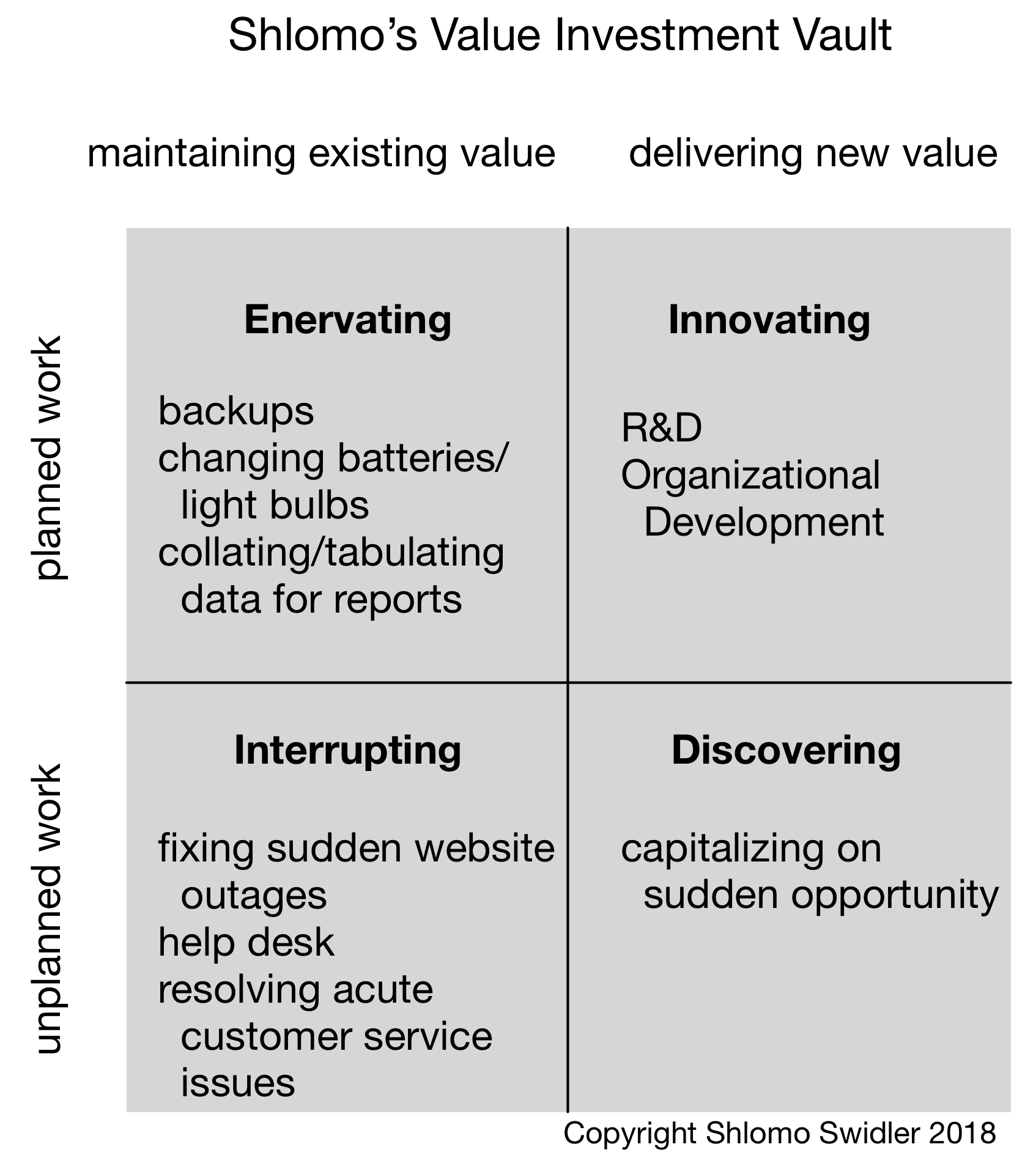
Your organization has one job: Deliver value to your customers. But not all kinds of value are the same, and not all manners of working to deliver value are equivalent. Do you know where your organization is devoting its resources? Let’s examine these parameters and how you can improve the way you work to deliver both kinds of value. Value and Work There are two types of value you can deliver: You can maintain old (already-delivered) value, for example you can restore your website when it goes down or you can repair a failed product. Or, you can develop new value, for example performing R&D for new or improved products. Both types of value are important to customers. ...

October 26, 2018 · 3 min · shlomo

Cost vs. Value

Are you in an organization that can not or will not fund improvements because there is zero cost-savings accrued as a result? Are important decisions forcefully hammered flat into a single-dimensional cost metric? Must you justify every action with a business case that boils down to a price tag? If so, I feel sorry for you. The most respected organizations in every field take a more mature view: Value, not cost, is king. And value attracts business. ...

September 20, 2018 · 2 min · shlomo

Digital Transformation, DevOps, and the Bugaboo of Change

How do you feel when you contemplate the idea of changing the way your organization operates? Scared? Jaded? Excited? Your answer—and the answers your employees give—to this question reveals how difficult it will be for you to pursue Digital Transformation and DevOps. This photo, ‘change machine,’ is copyright © 2009 tracyshaun and made available under a Creative Commons Attribution-ShareAlike 2.0 Generic License. ...

August 10, 2018 · 1 min · shlomo

Case Study: Innovation at Ticketmaster

One day I got call from an executive at Ticketmaster. They are a multi billion dollar company selling tickets to the world’s largest concerts and sporting events. Ticketmaster was having three problems. One problem came from the marketplace: Lots of companies were trying to get into the online ticketing business, like StubHub and other startups. These companies, since they were small and nimble, could do disruptive things quickly, so Ticketmaster was scared of them. ...

January 31, 2018 · 4 min · shlomo

Innovation Motivation

Have you ever seen someone sporting the latest and greatest in technical wizardry—perhaps they are very proud of their new iWatch—but you are unimpressed by it? Sure you have. You have also seen someone sporting the latest and greatest in technical wizardry—perhaps in 2007 you thought this about the brand new product called the iPhone—and you thought to yourself, “that really solves a problem I have; I need that.” What differentiates those two types of products? What can a producer do to ensure customers have the latter reaction, and not the former? I call the distinction Innovation Motivation, and it is described well by Shlomo’s Innovation Motivation Matrix (IMM). ...

June 29, 2017 · 4 min · shlomo

How am I doing? That depends who is asking

How good are you at your favorite activity? Wait—don’t answer yet, because you’re probably wrong. Your perception of how good you are is influenced by how good you actually are. This is explained by the Dunning-Kruger effect, which is cognitive psychology’s name for the disparity between self-perception and reality. Here is what it looks like: The Dunning-Kruger Effect demonstrates that the less you know the more you think you know. ...

May 23, 2017 · 2 min · shlomo

Software Factory Taxonomy

Do you wonder why your software organization struggles to deliver value rapidly, reliably, and consistently? It’s because something is wrong with either the organization’s structure or its relationships—or both. The software factory consists of its structure and its relationships. Some combinations are much more effective than others. The following diagram, which I call Shlomo’s Software Factory Taxonomy Matrix, illustrates this effectively. Organizations are structured horizontally, delivering a single functional area such compliance or QA, or vertically, delivering a single product or service. The inter- and intra-organization relationships are simple, when they don’t distract from forward progress, or complex, when they do. ...

May 17, 2016 · 2 min · shlomo